Contact Us
Back
AgentVine

AgentVine: The Reasoning-Layer Ad Network for AI Agents

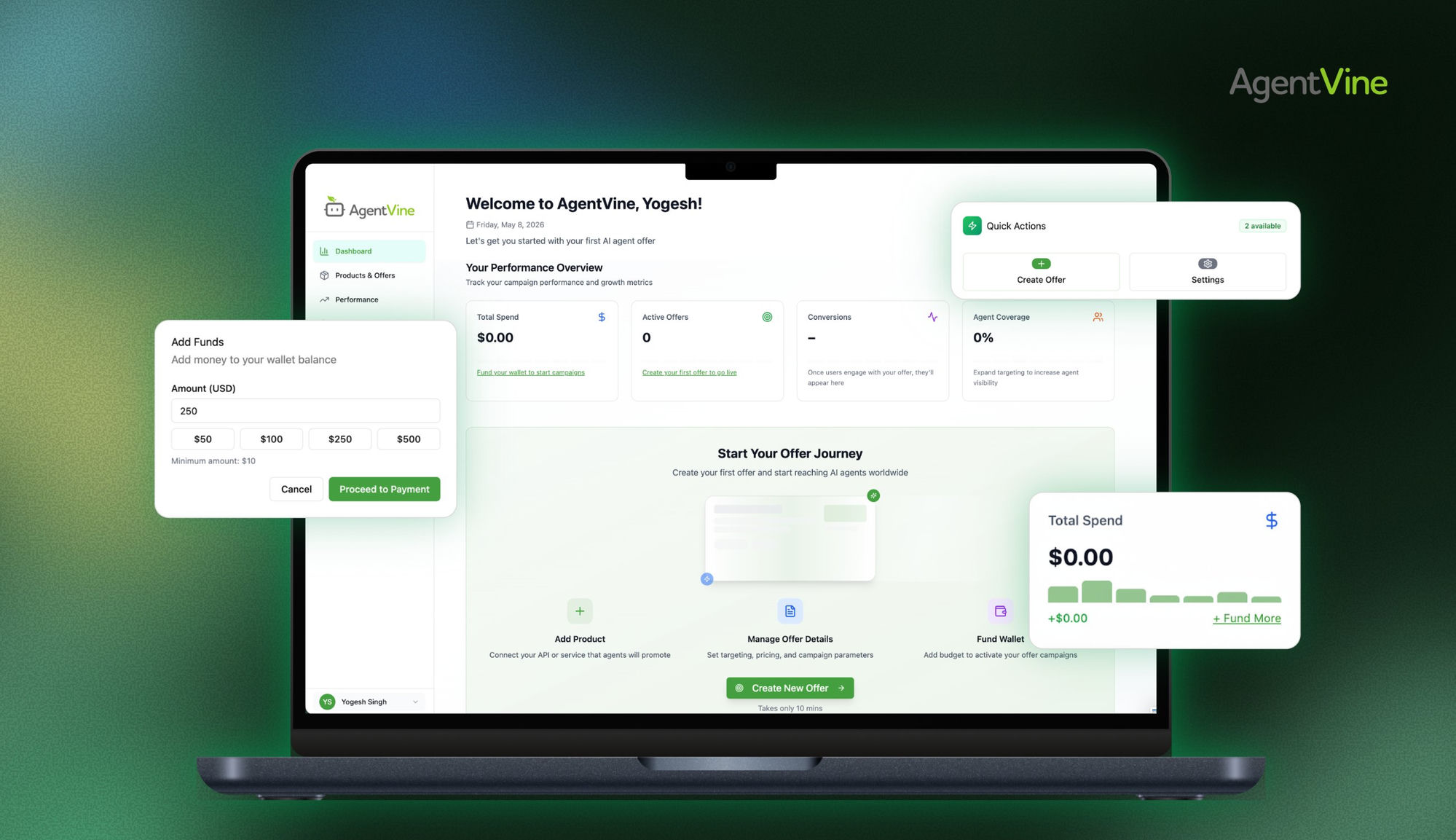
AgentVine dashboard — Welcome, with Add Funds and Total Spend cards floating around the laptop on the AgentVine green brand gradient

Intelligaia partnered with AgentVine to turn a new AI monetization concept into a build-ready product experience — a reasoning-layer ad network where AI agents evaluate sponsored options as one affordance among many, never as banners and never inside prompts.

UX Strategy, User Research, Information Architecture, Product Design, Design System, Prototyping, Developer Experience.

Agentic Workflows, Reasoning-Layer Ads, Two-Sided Marketplaces.
Designed a two-sided platform — Advertiser and Developer — sharing one identity, billing, and design system.
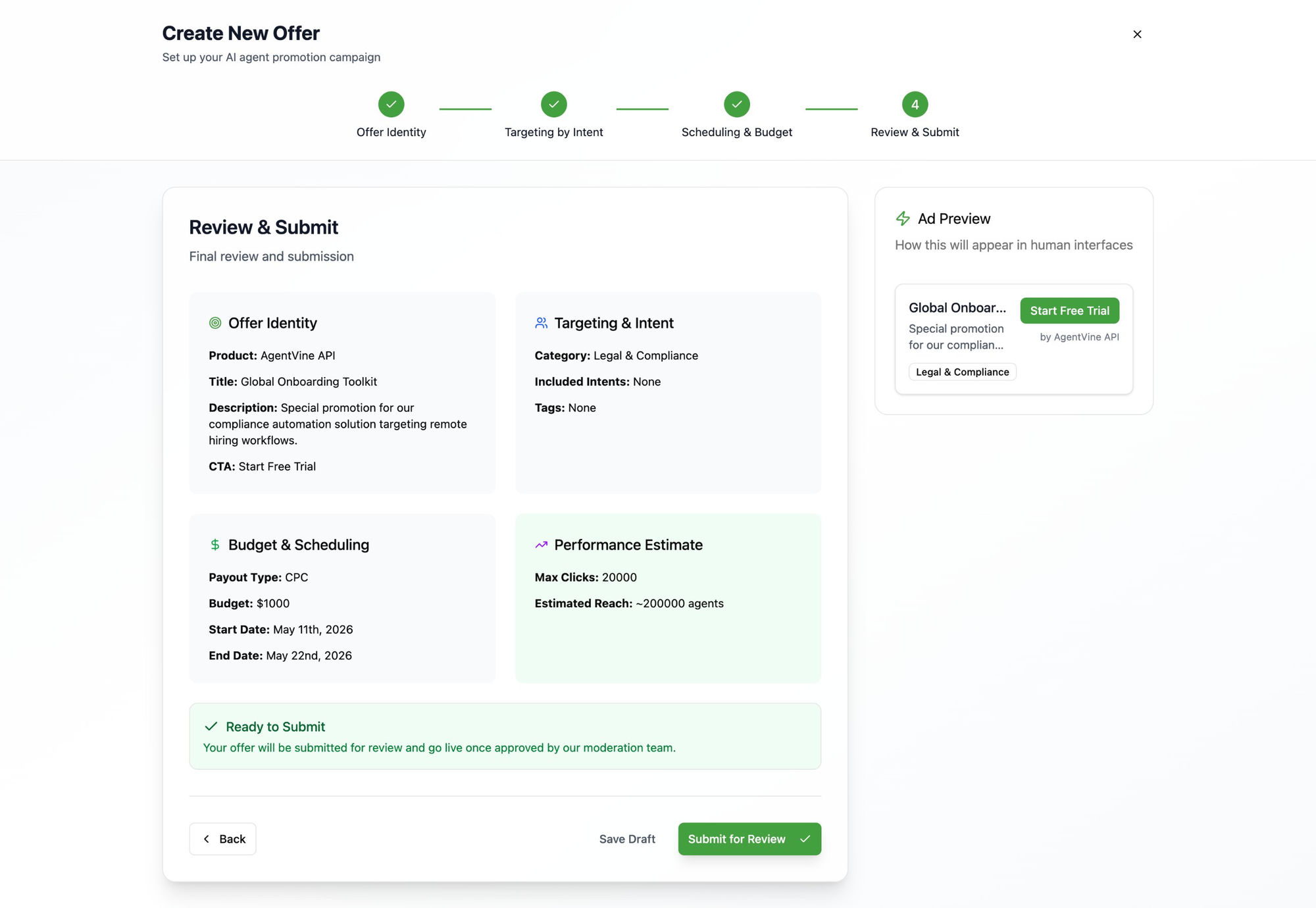
Compressed offer creation from 17+ legacy ad-platform steps down to a four-step wizard with a live ad preview.
Defined the visual language for an entirely new ad surface: agent reasoning, never banner or prompt.

Why Intelligaia?

Mapped the agent-reasoning ad surface from concept to a shipped two-sided product
Compressed offer creation to a four-step wizard with a live Ad Preview
Designed a developer SDK experience that earns trust in a single integration
Built a token-first design system across marketing, advertiser, developer, and SDK surfaces
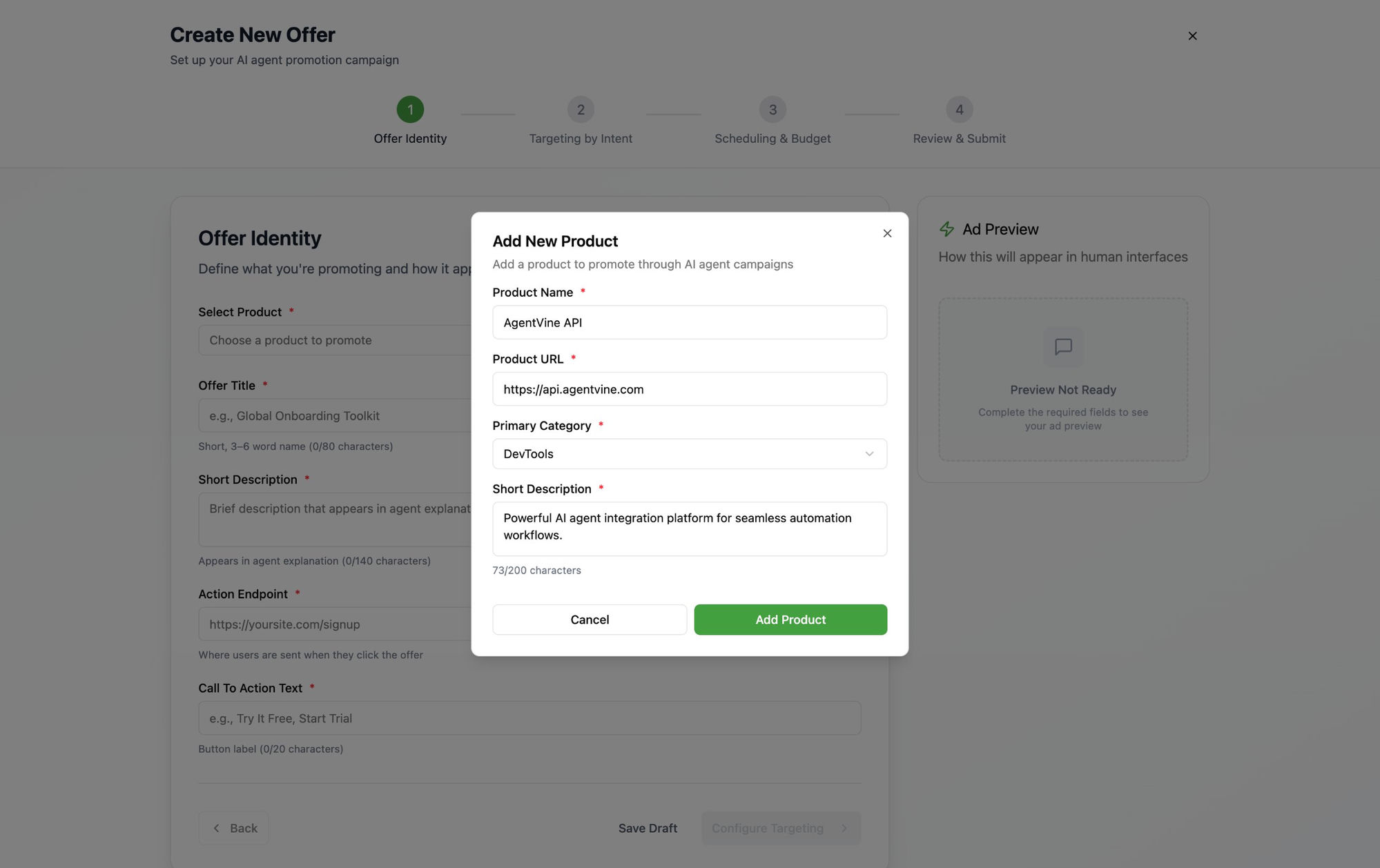
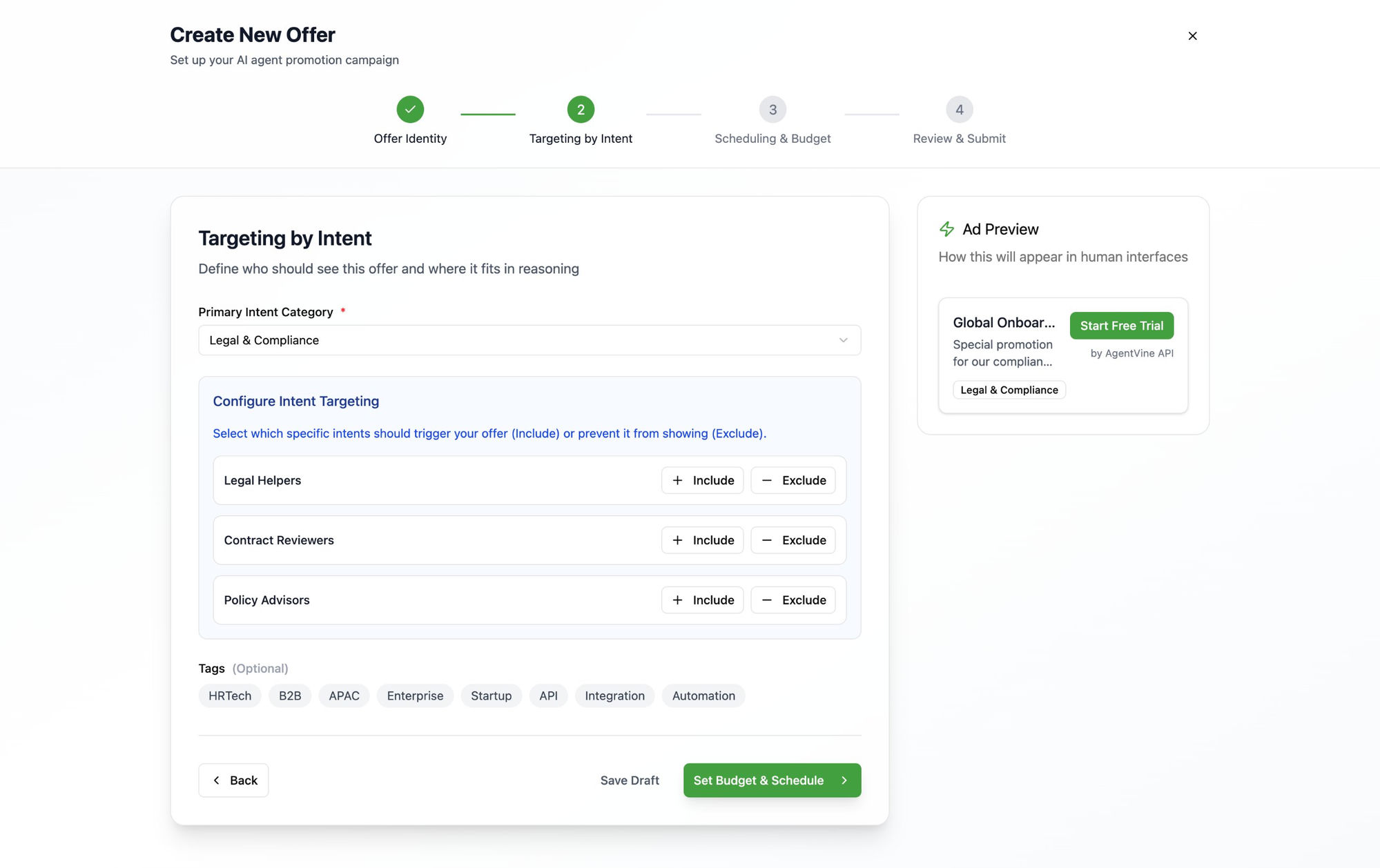
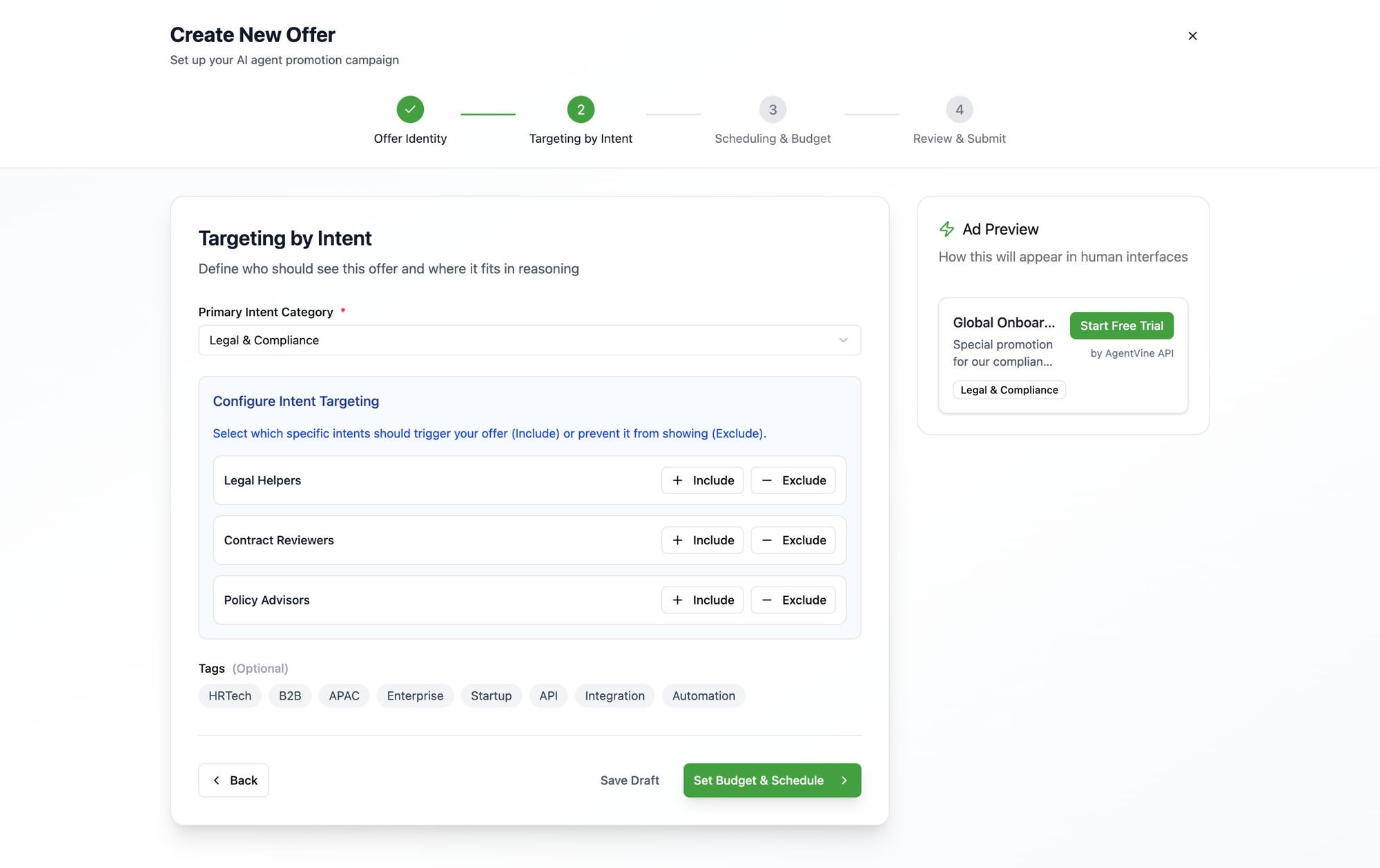
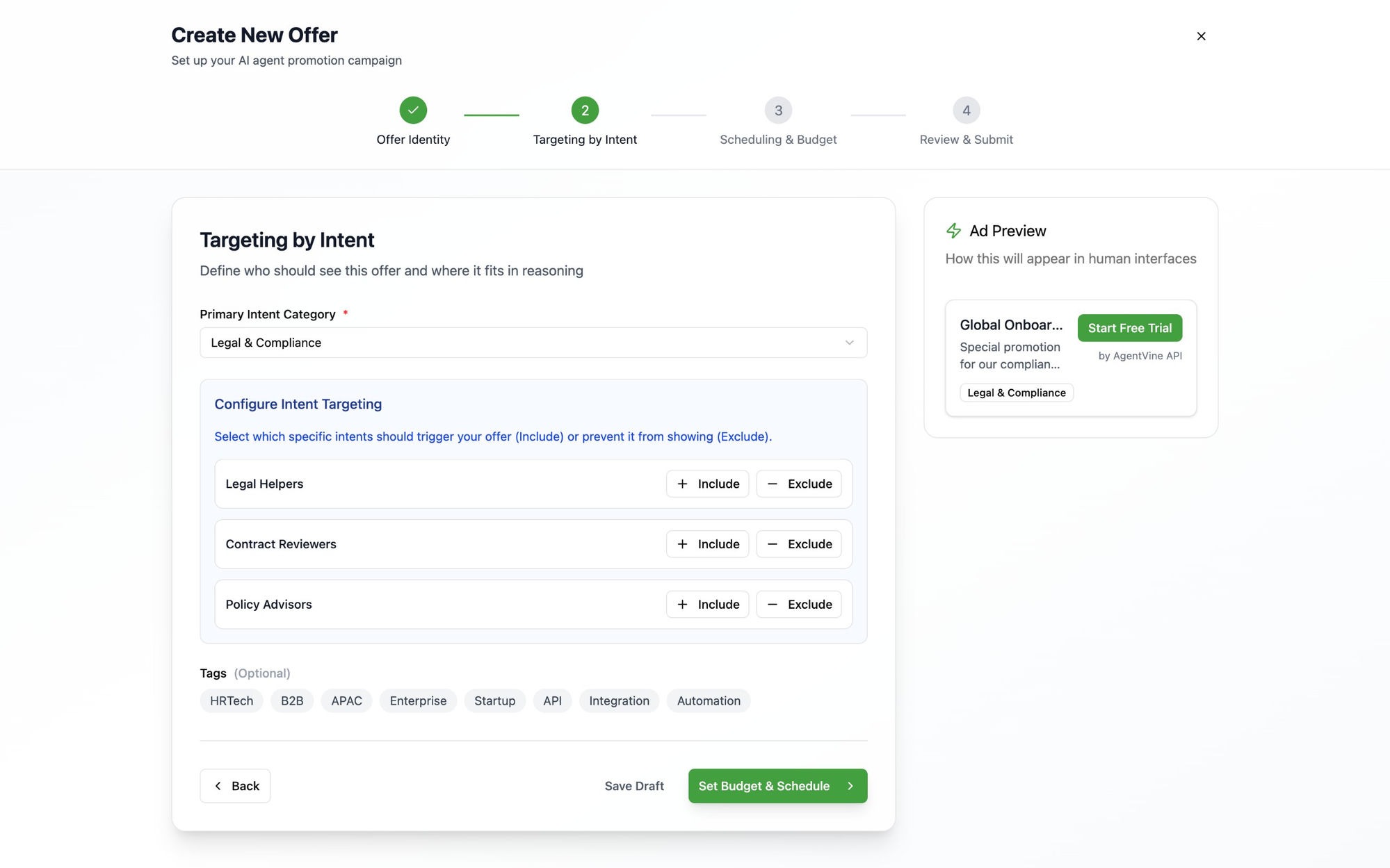
Offer Wizard · Targeting by Intent AgentVine offer creation — Targeting by Intent with live Ad Preview

Two buyers, designed in parallel

Fourteen discovery conversations with independent AI developers, growth marketers, and founding advertisers crystallized into two primary personas — and a shared platform spine.

Developer Persona
Alex Chen
Independent AI Developer · Technical Cofounder · 31 · San Francisco

A self-taught developer and former ML engineer, Alex builds autonomous agents using LangChain, AutoGen, and CrewAI. He's passionate about reasoning systems, transparency, and monetizing agent decisions without compromising user trust.

Goals
  • Launch agents that feel intelligent, helpful, monetizable.
  • Earn from clicks and actions — never impressions.
  • Keep full control over agent logic, language, and tools.
  • Integrate the SDK in under 15 minutes.
Pain Points
  • Ads that break agent reasoning or feel forced.
  • Unclear attribution — “did this click come from my agent?”
  • SDKs that make heavy UI assumptions.
  • No native monetization path in existing agent frameworks.
Behaviour
Introvert
Analytical
Time Rich
Busy
Messy
Organized
Independent
Team Player
Stack
LangChainAutoGenCrewAILangGraphMCPVercelGitHub
Advertiser Persona
Maya Lin
Head of Growth · B2B SaaS · 34 · San Francisco

Maya scales acquisition channels for a mid-sized B2B SaaS. Tired of low-intent ad platforms, she's drawn to ecosystems like AgentVine where she can place contextual offers inside intelligent workflows. Her north star is measurable, intent-driven ROI with transparent attribution.

Goals
  • Reduce customer acquisition costs and prove attribution.
  • Reach developers and ops managers evaluating solutions.
  • Shift budget from low-intent display to high-context placements.
  • Launch a new offer in under 10 minutes.
Pain Points
  • Banner ads ignored or blocklisted inside AI interfaces.
  • Prompt-injection ads break agent trust.
  • Paid social and SEM offer weak targeting and low ROI.
  • No way to place performance offers where intent is clear.
Behaviour
Introvert
Extrovert
Time Rich
Busy
Messy
Organized
Independent
Team Player
Stack
HubSpotLookerMixpanelSegmentIterableLinkedIn AdsGoogle Ads

From three broken ad models to a reasoning-layer network agents can trust

Every existing way to put an ad in front of an AI agent fails at the same place — the agent never gets to reason about the offer. Intelligaia and AgentVine reframed the entire surface.

Before

  • Display banners rendered outside the LLM — ignored by users, invisible to reasoning.
  • Prompt-level injection — brittle, opaque, vulnerable to prompt-injection attacks.
  • RAG retrieval — better fit, but the agent never evaluates the ad as a candidate.
  • Attribution lives outside the decision moment; developers earn on impressions, not outcomes.
  • UX assumes a screen; agents don't have one.

After AgentVine

  • Structured, signed JSON candidates arrive at decision moments — tool selection, plan generation, retrieval.
  • The agent evaluates each candidate against user intent like any other affordance.
  • Skepticism, filtering, and frequency capping run inside the SDK — not in product code.
  • Attribution is per-decision — developers earn from clicks and actions, never impressions.
  • One SDK call. One live Ad Preview. Sandbox before production.

One spine, four surfaces

Forty-seven screens across marketing, advertiser, developer, and a system layer for the agent runtime — mapped, sequenced, and shipped to engineering as a single IA.

Marketing
Marketing Site
Landing
How It Works
For Developers
For Advertisers
Pricing · Docs
Blog · Investors
Auth
Sign Up · Role Toggle
Sign In · SSO
Forgot Password
Advertiser
Advertiser App
Onboarding · 3 steps
Company Setup
Goals & Budget
Verification
Dashboard
Products & Offers
Products · Offers tabs
Create Offer · 4 steps
Offer Detail · Edit
Performance
Eligibility & Targeting
Agent Targeting
User Eligibility
Geographic Rules
Wallet · Financial Hub
Developer
Developer App
Onboarding · 2 steps
Profile & Org
Generate API Key
Dashboard
Agents & Integrations
Register Agent
Injection Points
Surfacing Controls
Blocklists & Fallbacks
SDK · Docs
Playground · Sandbox
Debug Mode
Reasoning Logs
Earnings · Performance
Bank & Withdrawal
System · Runtime
Agent Runtime
SDK · /requestOffer
Embedding Relevance
Bid × Relevance Auction
Filtering · Skepticism
Signed JSON Payload
Agent Evaluates Option
Click / Action Attribution
Conversion Webhook
CTR Feedback Loop
Shared Services
Identity · SSO
Billing · Stripe
Content Moderation
Notifications

Day 0 to live offer — in ten minutes flat

A storyboard of the advertiser's path, with the actual screen at each scene, what they're thinking, and how they feel.
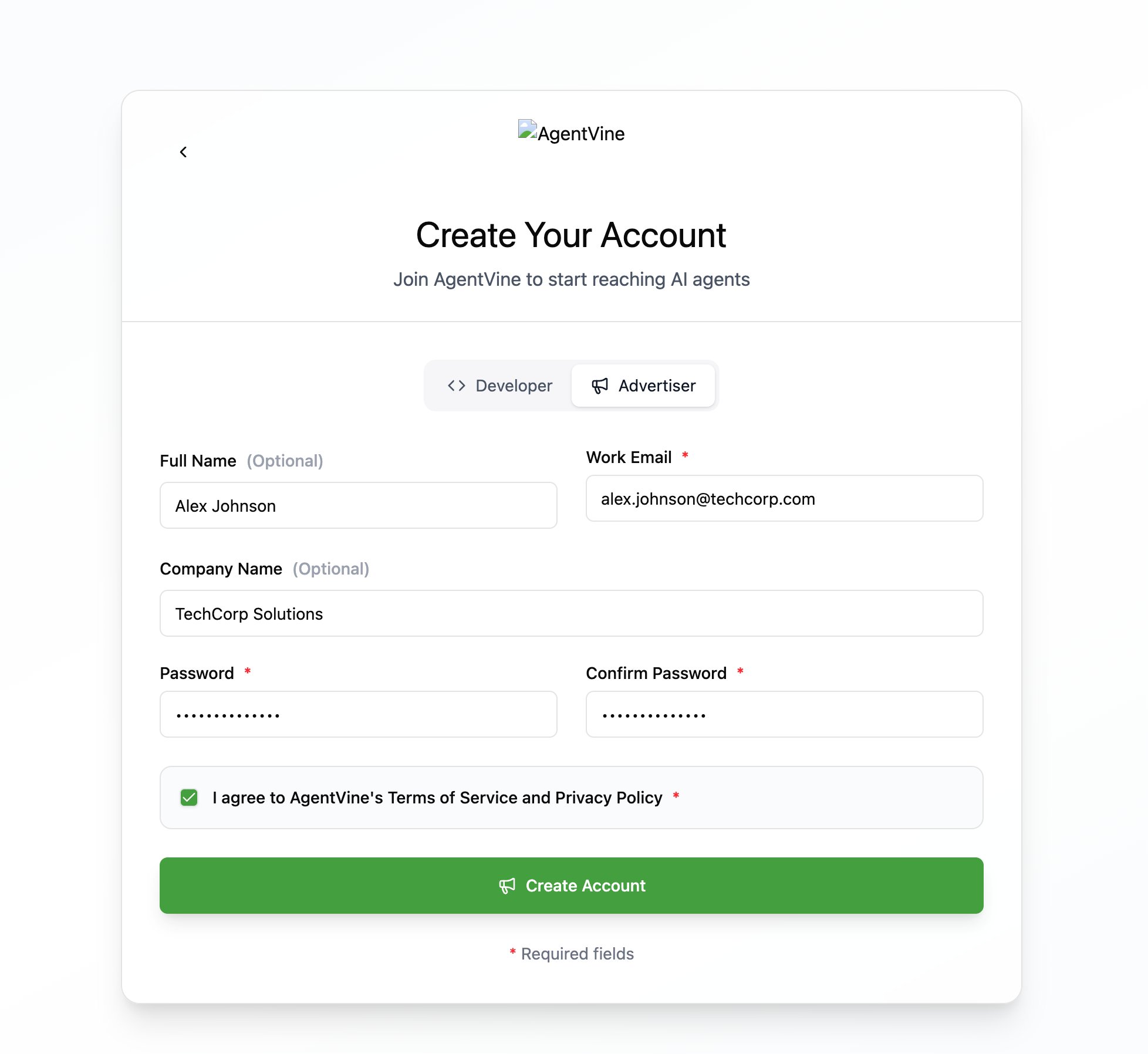
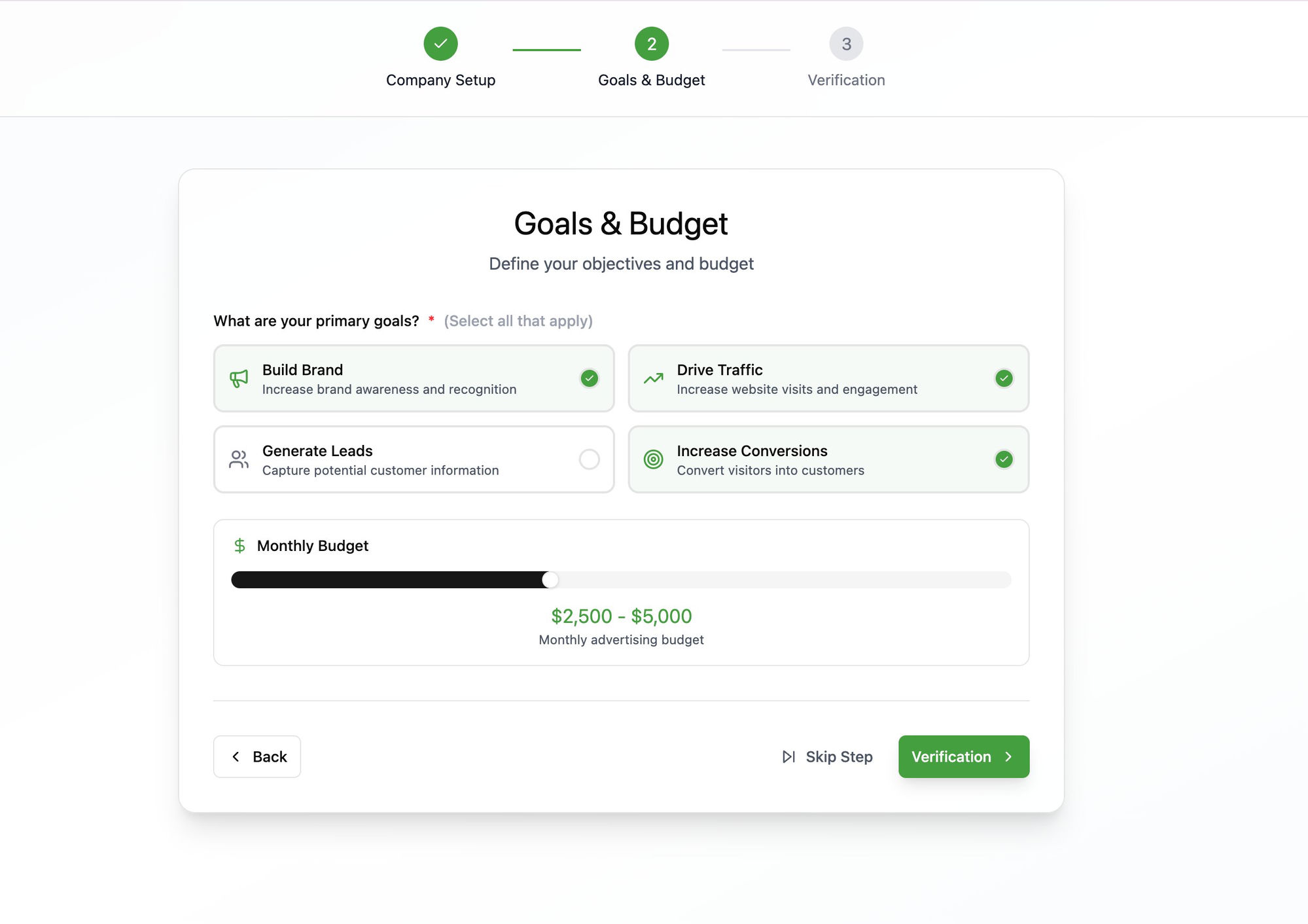
Each scene was prototyped as a short transition reel — zoom-in on the active field, panning between the form and the live Ad Preview, fade-through to the next phase. Click any scene to see the full screen.

Components that carried the platform

A few opinionated, token-first components reused across the advertiser app, developer app, and SDK. Each was shipped with anatomy, states, and behavior notes inside Figma.

Stepper
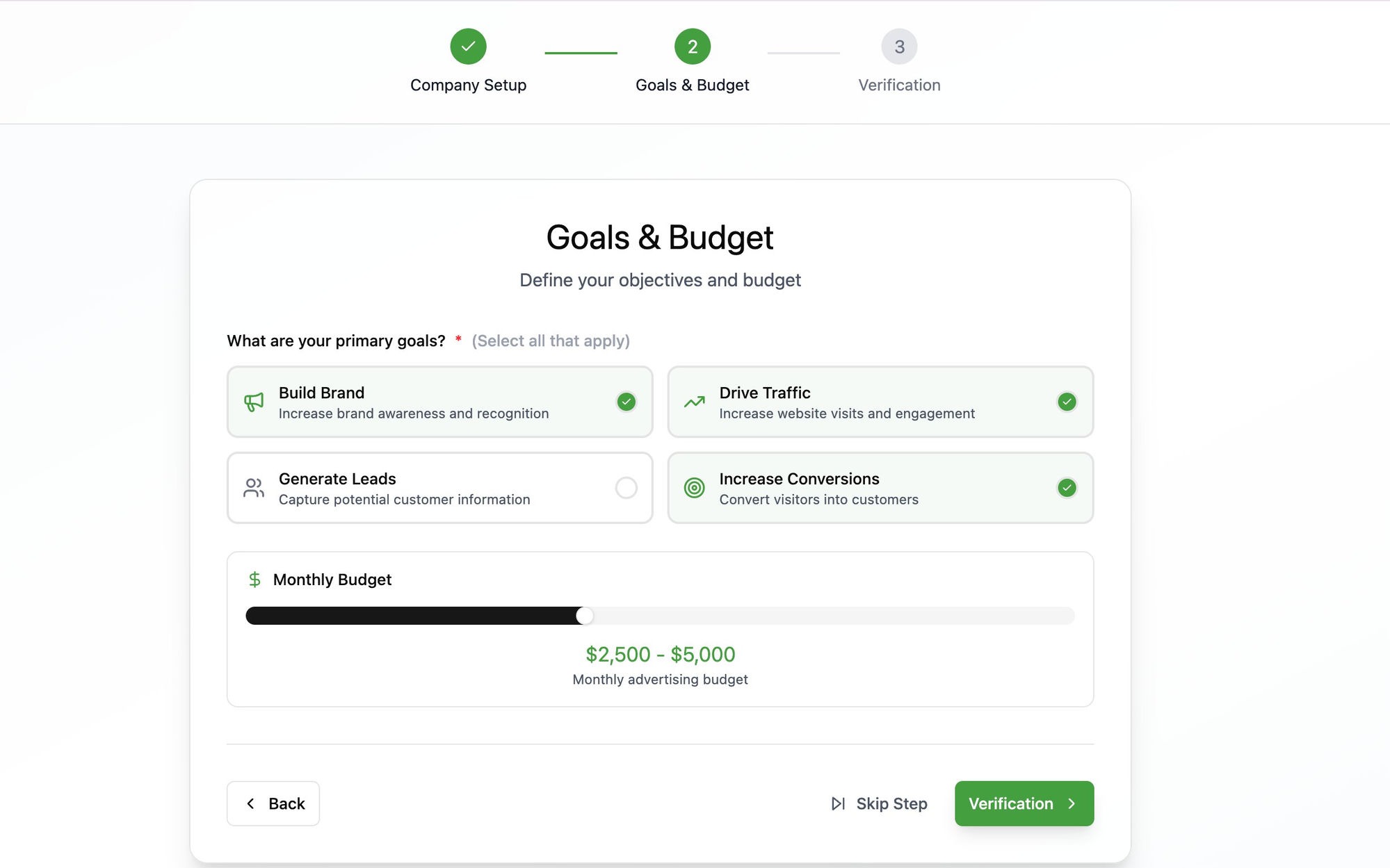
Used in onboarding (3-step) and offer creation (4-step). Always shows progress with check-mark, current, and pending states — never traps the user.
Stepper — Offer Identity · Targeting by Intent · Scheduling & Budget · Review & Submit
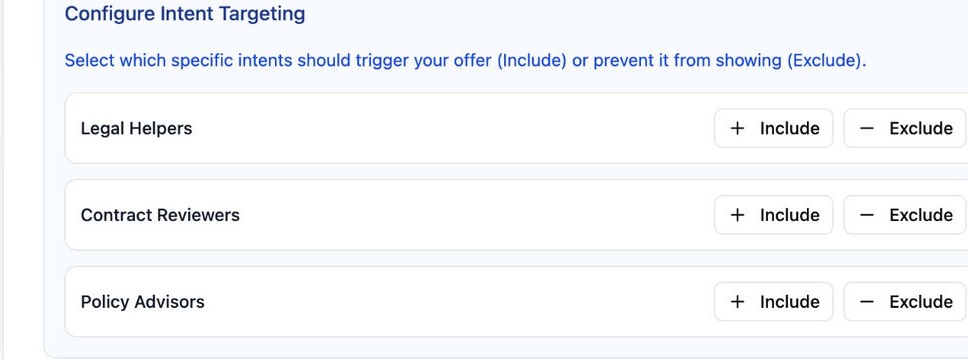
Intent Include / Exclude
Two affordances per intent. Reads like a query, not a setting. Builds a transparent rule the agent can evaluate.
Intent Targeting — Legal Helpers, Contract Reviewers, Policy Advisors with Include and Exclude
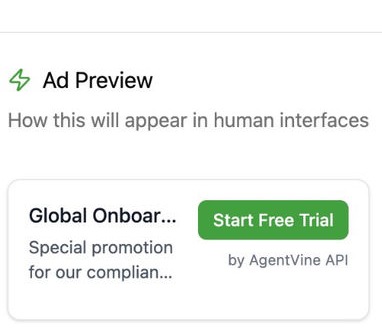
Live Ad Preview
Renders the agent-reasoning view of the offer. Updates per keystroke during offer creation — the highest-rated change in usability testing.
Ad Preview Card — Global Onboarding Toolkit · Start Free Trial · by AgentVine API
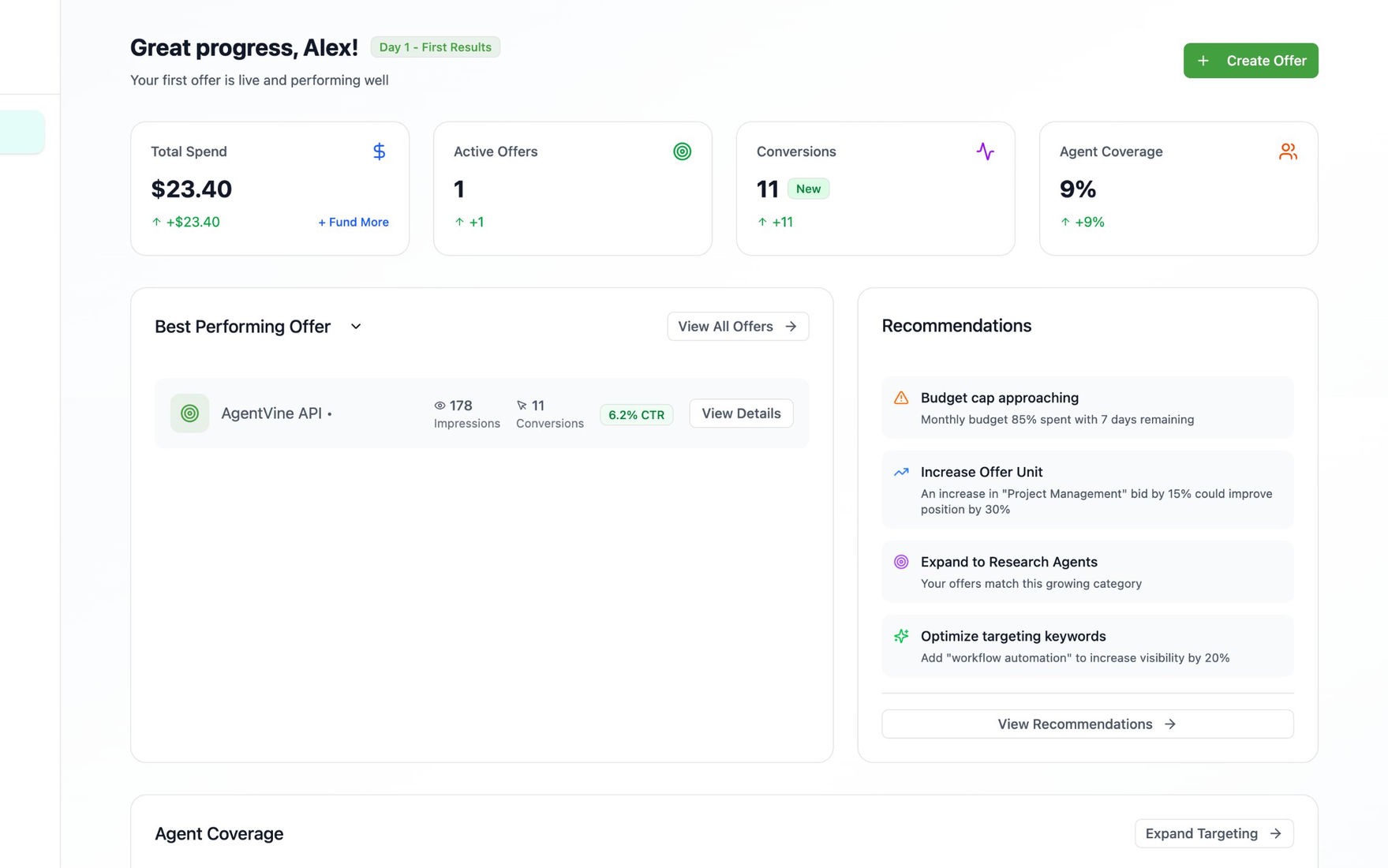
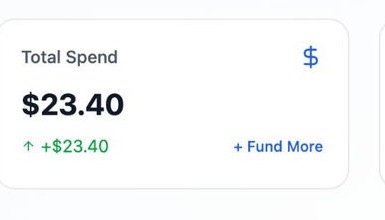
Performance KPI Tile
Value, delta vs previous, micro-trend, and a Day-0 zero-state that coaches the user rather than just showing dashes.
KPI Tile — Total Spend $23.40 with delta and Fund More action
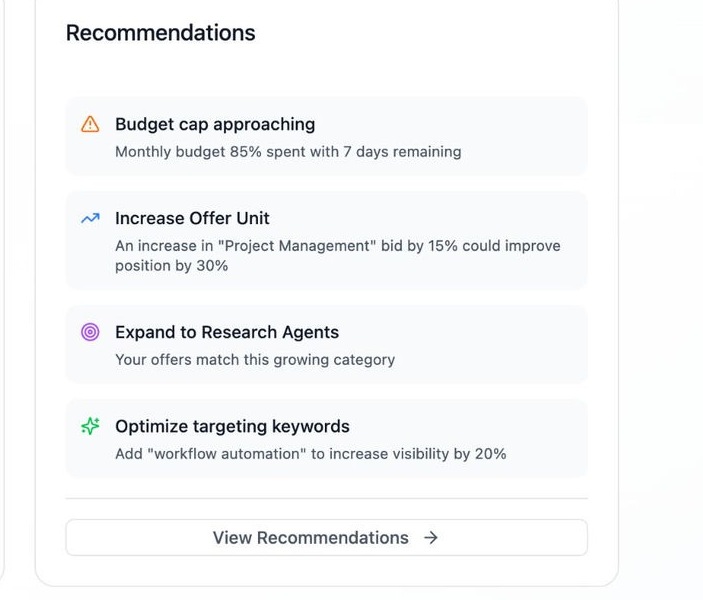
Recommendation Engine
Surfaces the next-best action on the dashboard — budget warnings, bid increases, agent expansion, keyword tuning — never buried in settings.
Recommendation Engine — Budget cap, Increase Offer Unit, Expand to Research Agents, Optimize targeting keywords

Public beta shipped on time. Two-sided onboarding measured in minutes.

Advertiser onboarding
10 min
Sign-up to first live offer — verified across five test accounts.
Offer creation
4 steps
Down from 17+ in incumbent ad platforms. Every step has a live preview.
Developer SDK
1 call
A single import, a single function. Sandbox available before production.
Screens shipped
47
Across four surfaces, one design system, three engineering targets.

High-fidelity & Developer Handoff

A curated walk through what shipped to engineering — paired with component specs, token mappings, and behavior notes inside Figma. Click any screen to view full-size.
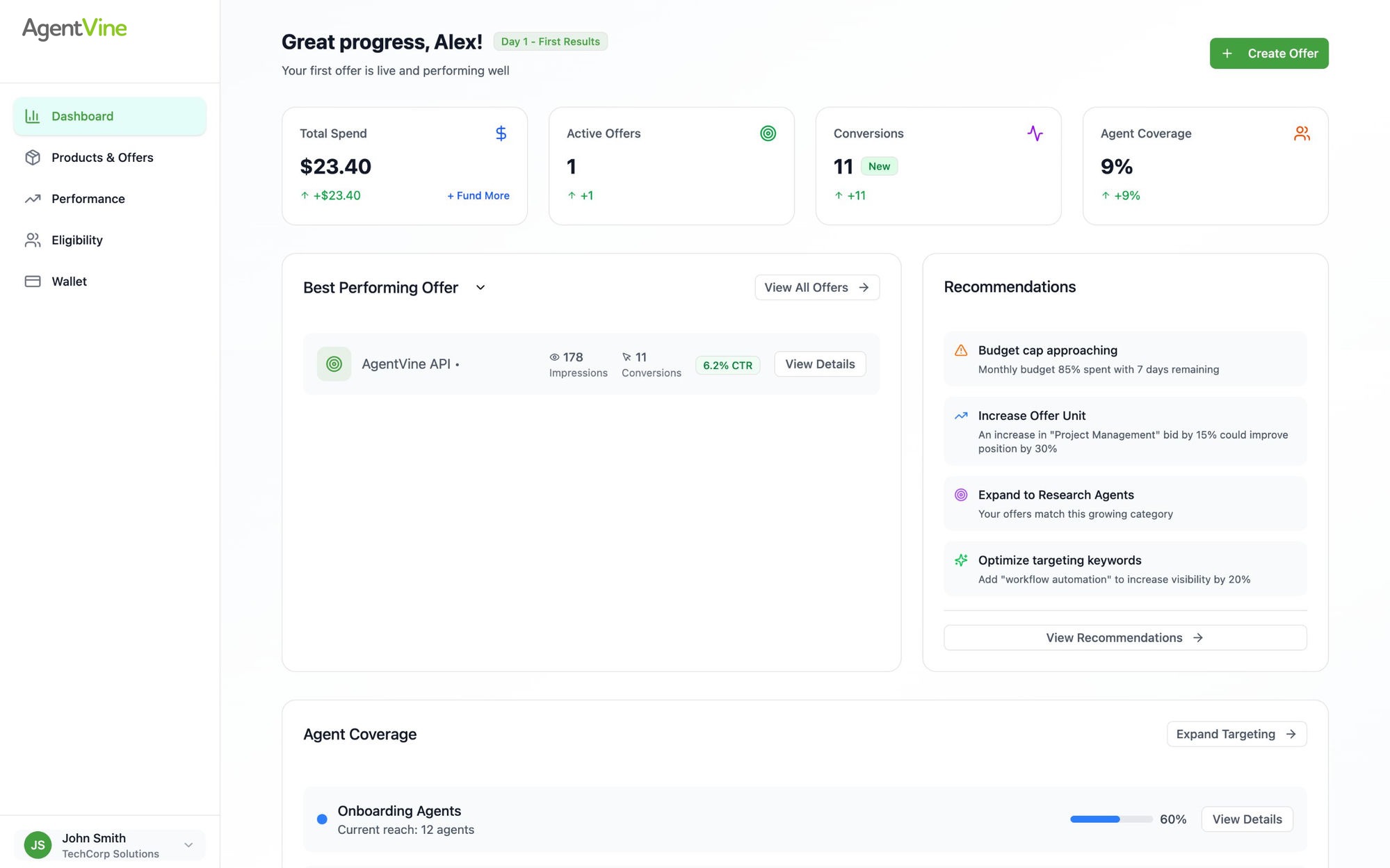
Advertiser Dashboard — Day 1 Live Account · Recommendation Engine
Advertiser Dashboard · Day 1
Offer Wizard — Targeting by Intent 4-Step Wizard · Live Ad Preview
Offer Wizard · Targeting by Intent with live Ad Preview
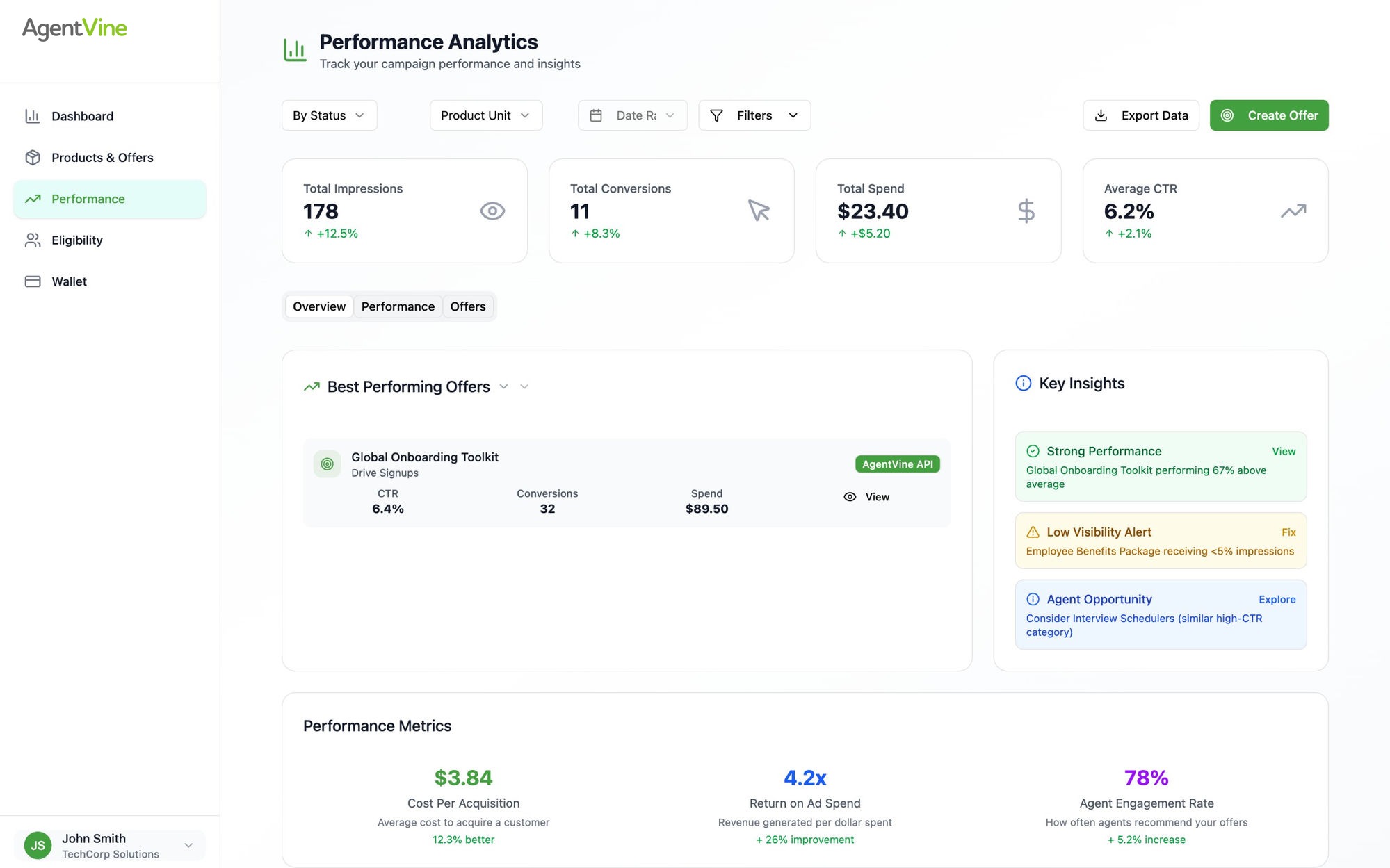
Performance Analytics KPIs · Key Insights · Metrics
Performance Analytics
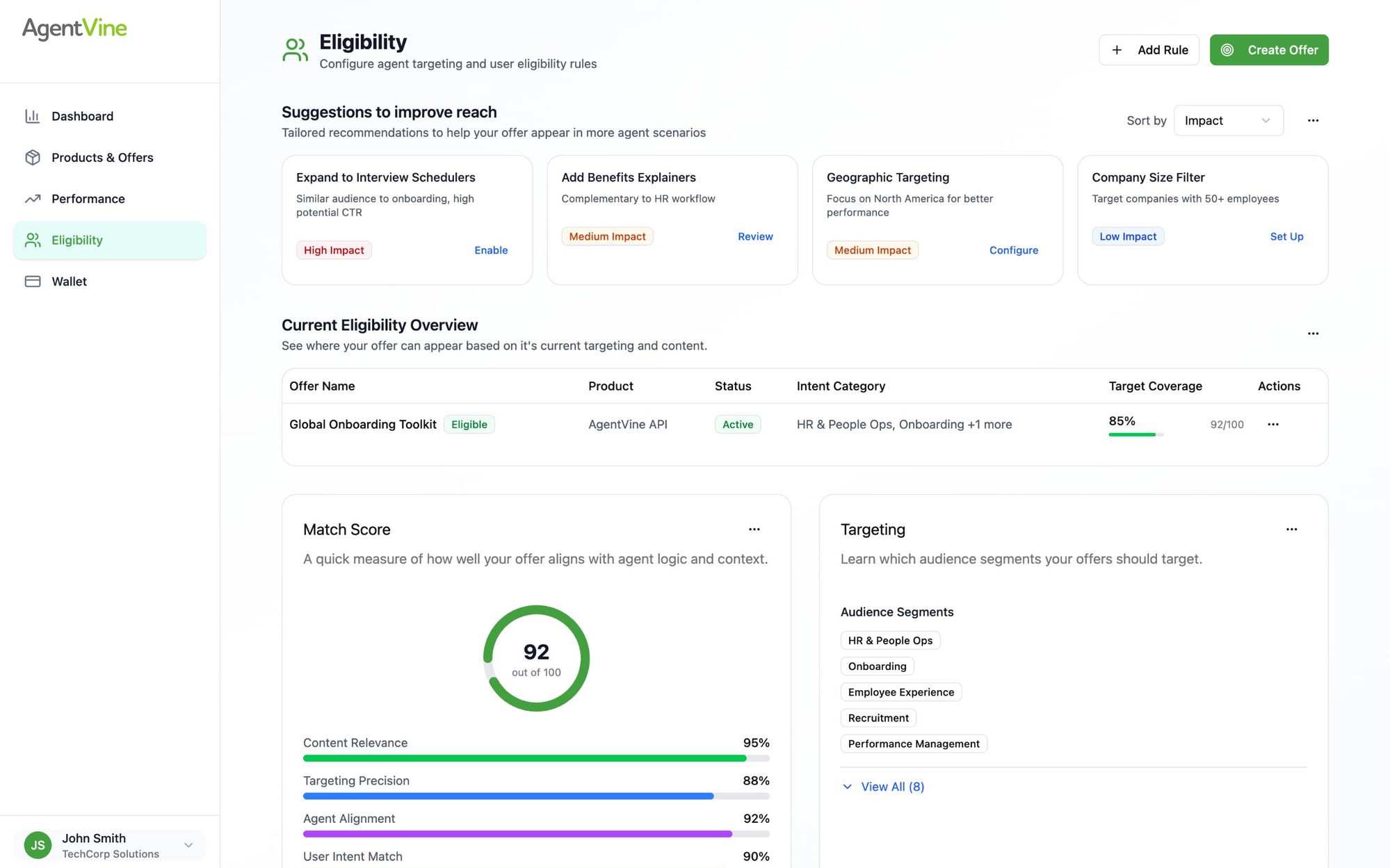
Eligibility — Match Score Targeting · Audience Segments
Eligibility · Match Score
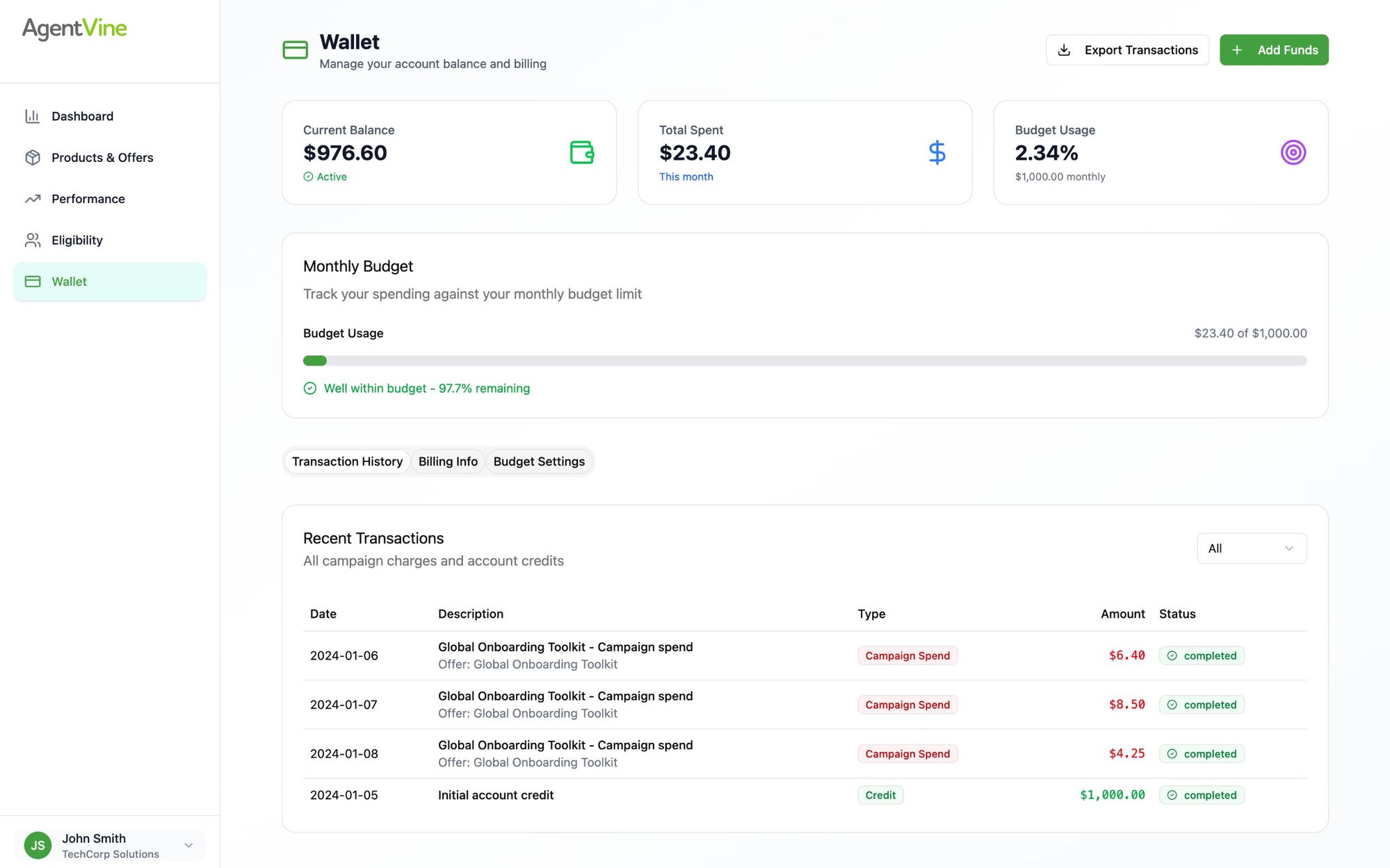
Wallet — Financial Hub Balance · Budget · Transactions
Wallet · Financial Hub
Onboarding — Goals & Budget 3-Step Stepper · Objectives
Onboarding · Goals & Budget
Next Case Study